Sunday, April 1, 2012

A Shifting Paradigm: Gender Gap Closing in Farriery


Women in the Professions:

[image: sandra mesrine]

 
Happened to be perusing a photo gallery the other morning that pictured opening day at one of America's farriery (horseshoeing), schools.  Eager faces -- almost like any freshmen class at university; studying the syllabus for the coming semester of studies.  But then, I noticed something else and began counting heads (or hats maybe), and noticed that...well, as best I could determine, that somewhere between 40 and 50% of the students were women.  Certainly not shocking, but like most trends, a matter of passing curiosity, especially considering that 20-years ago a female horseshoer would have been a rarer find than 10-cent coffee.  Drinkable coffee that is.  So I took a look at it.

The first obstacle was comparative statistics.  Of course, none exist.  While farriers in the United States have had professional representation for almost thirty-years, apparently nobody is very interested in how many farriers actually practice this ancient craft, much less how many women.  Naturally, this makes it pretty difficult to ascertain if this is actually a profession, or merely a weekend hobby for people with a blacksmithing fetish.  Demographics are critically important for a number of reasons, for in order to make critical decisions about an industry, any industry, one must be able to define the scope and economic impact at the center of the conversation.  Well, maybe some other time.

Women made their greatest inroads to both management and labor on the heels of the Equal Opportunity [in] Employment Acts (EOE), in the 1970's.  Initially, the increase was very dramatic, tapering off (but not down), after 1980.  Briefly, women in professions (2005 stats) were: Engineering, 7%; Medicine and Surgery, 38%; Management/Administration, 57%; Paralegals, 83%; and Dietitians (MA or PhD), 95%.  At the same time, these degreed professions also represented a 79% increase in income level over women with only a high school diploma.  Far more significant that the disparity among men.  However, the trend also produced a separate statistic on equality: no real distinction in unemployment rates by gender, meaning that in a recession year, joblessness is no longer the sole bastion of male workers.

But here we get stuck.  What do you compare farriery with when no suitable model exists and no information is readily available?  We always end up back at veterinary medicine if for no other reason than it might involve a horse.  That makes for a weak assumption at best and really limits the discussion more to sociology than economics, and just how they might intertwine. First obstacle: dramatic differences in the educational systems.  That amounts to a simple ratio of investment to potential return.  (Debt to Income Ratio)  Medicine requires a 7-year investment (at least), while farriery can be as little as 8-weeks.  Apples and oranges.  However, it has led to some dramatic shifts in veterinary medicine, particularly since the application of the EOE laws, which also ended all discriminatory application processes in higher education based on gender.  Canada alone, saw male applicants in veterinary medicine drop from 44% in 1985 to 28% by 1999.  US statistics mirrored those numbers.  But why?

Two papers, presented  [Carin A. Smith, DVM, Vet.Cln Small Anim. 36 (2006) 329-339 & Jeanine Lofstedt, DVM, Canadian Vet Journal, 6-03]  by these authors, basically came to similar conclusions, though placed different priorities on agreeable relevance.  Loftset noted these key themes:

For women:


1)  Elimination of discriminatory practices in education.

2)  Improvement of chemical restraint in large animals.

3)  Increase in number of female role models.

4)  Caring image of veterinarians portrayed through books and television.


For men:


1)  Low or stagnant income levels.

2)  Loss of autonomy in the profession.  Proliferation of 'corporate' practices. Decrease in number of practices relative to employed veterinarians.

3)  'Trend effect.'  More women entering the profession -- decreasing professional 'prestige' as a male occupation.  (Ouch!)  But in effect, reducing veterinary medicine to a secondary profession.  The old adage of a 'spousal' job.  [My words, not the authors.]

Cain offered a little different spin on what she referred to as the 'feminization of the profession.'  Most notably, the tendency (and market limits), for women to accept lower salaries than men, which in turn, drops the overall income level for all practitioners.  However, a caveat exists here:  Women don't place income as high on their list of expectations as men.  They (women), tend to find more satisfaction with lower incomes in exchange for a more subjective criteria:  primarily in relationships with colleagues, staff and clients.  She goes on to say that most men look at money as the objective criteria, and further that women are less likely to engage in 'practice ownership,' primarily due to competing demands.  Ownership rates: Men, 61%; Women, 38%.  Almost opposite of the figures applying to veterinary schools.  She goes on to note that it would appear that the levels of care and nurturing have increased in proportion to the number of women entering the field (admittedly difficult to qualify), at the expense of decreased income, but most of this seems to be in the areas of personal preference and lifestyle choices.

So here we are again at what we can now call the 'feminization of farriery.'  Has a nice ring to it, don't you think?  There is no doubt it is happening, regardless of the inability to capture the numbers.  Will it change the profession.  Certainly.  Will it diminish the profession's stature economically?  Not likely.  It may actually improve the picture, for women have an uncanny ability to look beyond the bare-bones economics many men choose to practice.  But in the end, we may never know the answer anyway.  For as long as the profession (by popular accord it would seem), remains in the shadows of the mainstream --  no argument, analysis or projection is practical or possible.  And just maybe it will be the women professionals who finally lead horseshoeing out of the deep, dark recesses of our past.  Or not.

Sunday, March 25, 2012

Next project, please...


Ah well, 25 days overdue, but who's counting?

Novel.  Tops out at 397 pages, off to the Editor and her vicious red pencil.  On the street...late summer if I get my ass in gear.


Nothing like a quick self pep-talk!

Saturday, March 24, 2012

Back to Shameless Commerce...It is Safer

[image: ajuell]


The Wonderful World of Opinions:


You can never argue with an opinion.  Maybe the merits, but not the message.  However, you can write a book, call it fiction and then run away to Panama and open a gas station.  That is the marvelous part about granting an opinion via a literary license.  Sort of a passive-aggressive case of 'putting money where your mouth is' maneuver.  If the Library of Congress goes for it...the opinion lives long after the author's final breath.  Gotta love it.

My last two posts were a reversion actually, kind of like when a person constantly repeats themselves to see if anything has really changed.  A bad memory test in that if nothing has changed, then what are you left with really?  Less oxygen and the same damn elephant that has been parked on the living room sofa for what?  Thirty years or so. 

At least five times I have said, "You know Andy, you oughta toss that speech out the window."  Probably good advice, but it is not the speech that appears to be the problem, but rather the audience.  Every performance earns a spattering of polite applause, the usual,  "Go f...yourself!" some slightly dishonest agreement veiled in a covert --  you know, e-mail versus something  with witnesses in the room, and the elephant just yawns and drifts off into an incontinent sleep...and I watch the urine flow downhill and pool around my feet. 

I think I should really dispense with the practical, toss out the logical and focus more on primal psychology, because it seems that the real issue revolves around security and safety.  The notion, at least for many farriers, that a credo, a rule, a measurement...no, not a theory, too vague -- charts, graphs, blue prints...a gold star on a 3rd-grade essay.  Security through external validation because the rest always produces doubts.  Doubts threaten safety because someone will always ask you to explain yourself.  And of course, you can't.  Not to the owner's satisfaction or perhaps even your own.  The average shoeing job probably has four explainable aspects and twenty-some variables that sound like either Bulgarian voodoo or something related to ship construction.  Black and white, at this point, has left the room.

Then we have the other camp.  Those folks that instead of swimming from a marauding shark, want to stop and seek an opinion about the shark's motivation.  Horseshoeing is an adventure, a great leap into the unknown world of Einstein's private musings.  One of the only real opportunities to throw off the yoke of conformity and stretch very basic abilities and skills into something more meaningful.  They only see rules, certifications, tests, questions...as impediments to creativity; certainly as no protection from the uncertainties of the task at hand.  Because the truth is that they thrive at the edge of the precipice and would have it no other way.

And so the two-camp struggle continues while the elephant quietly dozes.  Those that see the posse of real-world probabilities getting ever closer, and the casual outlaws of non-conformity who simply mask the trail behind them and hope for the best.   Neither camp is right and certainly no camp is wrong.  So far the real world has only managed to catch the occasional interloper, leaving much of the mob unscathed by the burdens of conformity.  Sure, that could change, but no threat currently looms on the horizon.  None that hasn't been seen before in some other guise or ugly apparition. 

So we really have what could be called a 30-year impasse.  The question though is whether the time has been well-spent.  Personally, I don't think so.  I see the same issues, concerns, divisions...more seem to be added with time, and of course the aging elephant on the couch.  It would seem that it should be the business of all farriers and their representative groups to put these scared cows we seem to either covet, or maybe morbidly fear, on the agenda of official discussion.  Contests and education are excellent pursuits, socially and as an adjunct to building a better business.  But it is not and has never been, enough.  You need to ask yourself and more importantly, your representative group where they stand and just how they plan to address any and all concerns facing farriery as a whole.  And in case you haven't noticed, the age of the individualist vanished some time back.  We live in a world of political armies.  Become one or surrender to one. 


Wednesday, March 21, 2012

First Science, Then the Ever Dreadful...License.


A Licensing Primer for Horseshoers:


The other day I was musing over the dangers associated with too much science in a litigious world.  That naturally instigated another discussion, that being the long-argued issue of the licensing of farriers in the United States.  And yes, as always it invoked a lot of opinion, a certain degree of hysteria and like rats dropped out of a sack, a wild scramble to the outreaches of imaginative argument.  But...first things first. Before everybody turns into self-righteous barn burners, consider the following as a primer to any discussion on the topic.  It will be better for your blood pressure.


1)  Nobody in government is particularly interested in licensing you anyway.  First off, licensing needs to be cost-effective to a government entity.  If the cost of administering a program exceeds the financial benefit to the state, forget it.  Only exceptions are public safety and public outrage.  As one writer stated the other day, you would definitely want the FAA looking over a pilot's shoulder, but somebody's horse?  Unlikely.  And if you have trouble with this argument, you haven't flown in the Third World lately.  Considering the number of farriers operating above the radar, the numbers do not jive. 


2)  What about the racetracks you say?  Well, horse racing operates under a broader headline called, "the rules of racing."  Vague at best, but necessary because gambling is involved; public money and public trust.  That is why all professions associated with racing must be licensed.  This process has far more to do with integrity and criminal intent than shoeing or plating.  Licensing of platers was initiated to 1) try to remove the variable over individual skills and 2), assure the same level of scrutiny for all who have access to the horse.  All licenses issued must address the issue of 'qualified.'  That means everybody.  


3)  And while we're at the track -- consider jurisdiction for a minute.  Only practical approach is on a state level. Not county, not federal...the US never quite finished the Civil War.  As such, we are heavily burdened by the concept of 'states' rights.'  Any licensing considered would have to be at this level.  Now, what can occur and would be deemed 'enlightened thinking,' is a federal minimum standard, conceivably created by an organization (such as the AFA), that could prove its worthiness in maintaining such a standard.  Of course, they would have to get the individual state chapters to agree.  Lots of luck there.  The 'enlightened' part can be distilled out of the current jurisdictional quagmire that best describes the current state of American racing:  38 different sets of rules for the sport.  One for every state that conducts racing within its borders.  It is a ludicrous system, based more on jurisdictional greed than good clean fun. 


4)  Forget the European systems.  Europe has a very long (historical/political) relationship with its guilds and unions.  They are part of the culture.  Some critics have also accused them of being cumbersome, as well as non-viable economically.  Yes, the education is quite good, though comparing it to the costs and investment in time, these programs cannot compare favorably with formal education in the arena of financial return.  That can be answered in some ways by, "So what?"  Life is about choices really, and everybody does their own math in that department.  That grant aside,  the European programs do have one huge advantage, that found in the realm of 'accepted credibility,' over and above the current American reliance on self-accreditation -- good will and air mostly.        


5)  But how you say?  First off, study some union charters.  Most unions (electrical, sheet metal workers, etc.), have an existing charter with the state they are licensing within.  These could be seen as both a structural template and perhaps of greater use, identifying the nature of the current relationship.  Is it even applicable?  Probably not.  All government jurisdictions have strict codes to insure the proper use of materials and skills as they apply to public safety concerns; further to discourage or prevent fraudulent practices.  The question that arises here, and it is an important one, is whether or not farriery, as currently practiced, poses any such reasonable concern in the public sector.  Doubtful at best.  Bad shoeing, however you dare define it, is primarily a civil matter between practitioner and client.  There is no third-party offense involved.  And forget the horse.  He is legally chattel. 


6)  Okay, so why even bother?  That question is the sticky wicket as I like to call it.  And that is why I ask the reader to think in reverse.  Any type of licensing, regulation or restrictive trade arrangement  is not meant to control, chastise or hinder the professional.  It is to protect the trade, your economic standard and most importantly...keep the idiots out!  I notice a whole bunch of pissing, moaning and sulking about these barefoot imposter's running amuck and until members of this profession make the hard decisions, that's all you've got.  My suggestion is to shut the fudah up or do something about it.  You have a national association (sort of), and that last question is directed at the leadership.  And too, at all members and non-members of this profession...if it cares to be a profession.  A great deal of American culture (unlike our European counterparts), is based on a sense of freedom and individuality -- okay, the honest definition:  we're all a bunch of outliers.  Horseshoers somewhere near the top of that list.  In some ways, it is admirable.  But, you can't have it both ways in a society that doesn't always share in your enthusiastic disregard for the rule book.  Protect yourself and use the system to your advantage.  Before you discover the real price in maintaining that independence.


Having said way too much, all comments can
 be sent to my PO box in Panama.
Thank you.       

Sunday, March 18, 2012

Careful with the Test Tubes, Folks. Ol' Dagget's Lurking About....


Science or Art in Farriery:

 Are They Really Compatible in a Litigious World

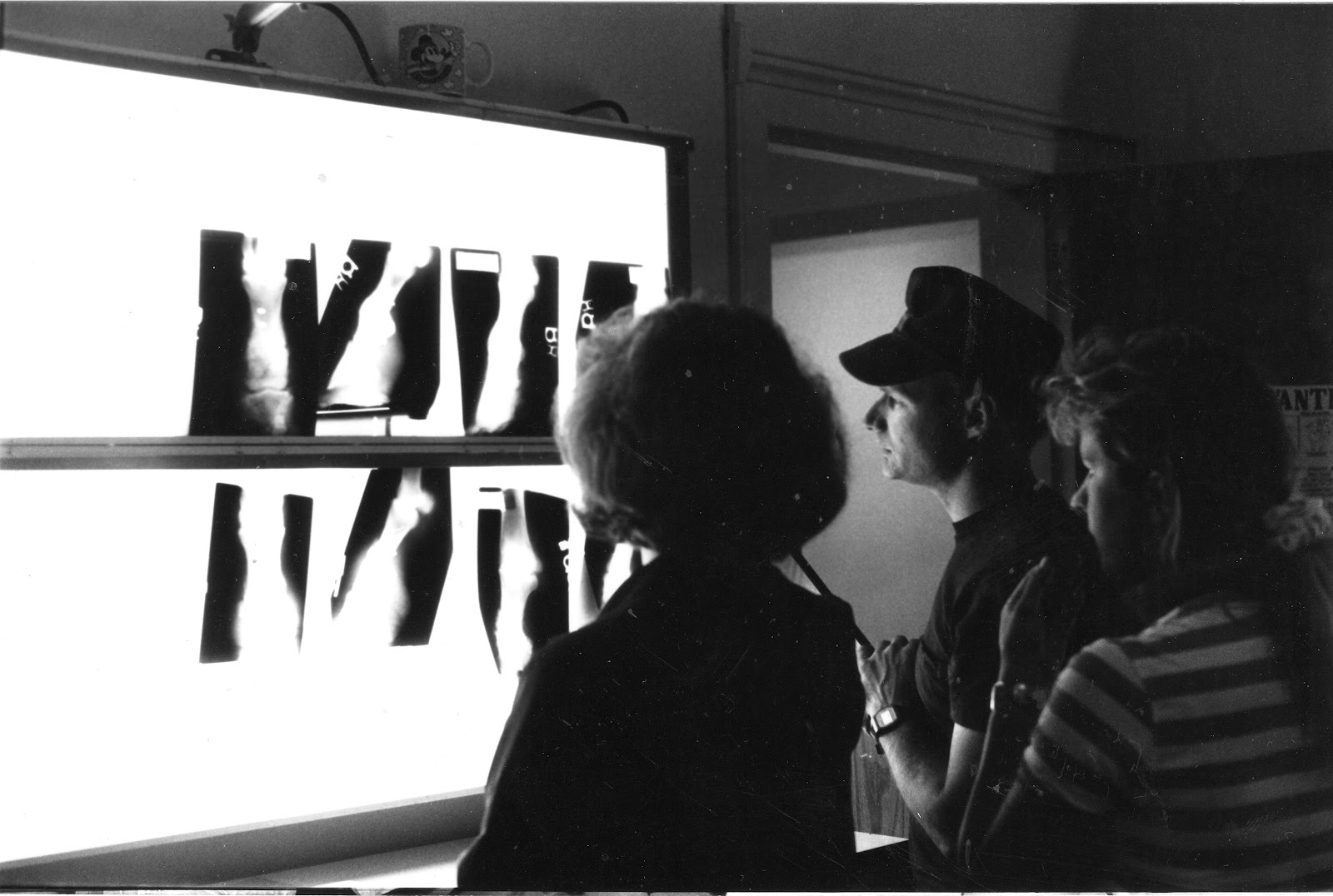
Kirk Adkins (in his distinctive hat), Resident farrier: UC/Davis, circa 1993
[image: ajuell -horsetrionics.com]


Seems to be a lot of discussion of late in farriery circles concerning certification, therapeutic principles and techniques -- maps, charts, blueprints on what might or might not constitute competency; proper medical protocol, liaison with other professionals, consistent nomenclature in the workplace...hell, whether it is ethical to warm up a burrito in a gas forge. You know, cross-contamination issues.  Science on the march once again.  Now don't get me wrong.  Science is good.  Research is good.  Cooperation among professionals is good.  Thorny sometimes, but still good.

Part of these debates surround the age-old search for standardization in a business that has few rules and probably doesn't need that many anyway.  That does of course fly in the face of the declared premise behind these trade certification programs, but concurrently may also represent the Achilles heel of any such program.  To be clear, it is a system of self-certification based on what can best be described as an educational system that runs the gauntlet from good to sub-standard, most, if not all offering no accepted mainstream credentials to the student/graduate.  Yes, there are exceptions.  And before you start yelling heresy, let me also say that today's system is a vast improvement over what the previous decades were able to offer.  Better, but still lacking.  And no, not on the day to day skills necessary to shoe a horse adequately or even exceptionally, but the overall reality needed to confront those assumptions accompanying that simple piece of paper:  the certificate.  These are rarely taught and often not even acknowledged.  Why?  Because the ground beneath these issues tends to liquefy in the presence of our legal system. 

Academic medicine (the veterinary variety), is an excellent place to begin a discussion.  Our mutual professions very often rub elbows, perhaps more than we should at times, but we still run in the same circles.  Having some experience in a teaching college (both UC/Davis & WSU) the former in the capacity as a resident farrier (interim), I have observed the development of that profession first hand.  It is long, difficult, complicated and as thorough as possible -- and accredited by the state.  My point here is not to argue the merits of a superior educational system.  That is obvious and not under debate.  My point instead is the nature of the work I performed under the auspices and protection of a teaching hospital in the university system.  Which means I performed very complicated tasks, aided or implemented procedures, conducted surgery (sorry, but if it bleeds, that's surgery), and a host of activities well beyond my job description or personal comfort zone; ethically speaking here, and in relation to the outside, real world.  A world where the only protection you have is common sense and integrity.  Or maybe a lawyer of your own.  The key word here is protection.  I operated under the umbrella of the Veterinary Department.  That allowed a certain degree of perceived (another tricky word), immunity.  It should also be noted here that most teaching hospitals are also the institutions of last resort.  Meaning we get more hopeless cases than hopeful ones and are bound (ethically and legally) to treat these cases.  I'm sure your imagination can extrapolate that sorry scenario into what it was like some days. 

I also worked extensively under both ASHA and FEI rules and additionally was licensed to work on the tracks.  Not terribly important, but different rules and jurisdictions can and will dictate the parameters of how you conduct your business.  This is because these rules, limitations and forced adaptations are your responsibility when it comes to compliance.  And in the end, you are the ultimate insurer of certain potential outcomes you might not even be aware of at the time.  A few examples:  I once contaminated a horse on race day with Lidocaine.  Casual transfer.  Another time I refused to work on a jumper at a show. I was called into the Steward as I was listed as the 'official farrier.'  I had the ability to make the horse visually sound, but I also knew if I did, this would be the horse's last show. And finally, perhaps fittingly to this discussion, just about any laminitic horse you care to point out.  All too often they are the victims of wishful thinking and accepting such a case with little or no veterinary supervision leaves you, the farrier, completely exposed.  And forget about what a nice lady the owner was.  Dead horses tend to change people's persona pretty damn fast.

Now, I've shared a bunch of my dirty laundry for hopefully a good reason.  As I said earlier, science is good...blah, blah, but for all our good intentions, humanitarian principles, our pursuit of continuing education and that pile of expensive and time-consuming certificates -- we are no match for a university education when ol' lawyer Daggett has our sorry ass in the witness chair.  Game over.  I have had some experience in litigation cases involving farriers:  wrongful death, [in]competency claims, property damage or loss of use (do remember that horses represent chattel), and one fascinating case where a farrier was shot by mistake.  And here you thought this job wasn't too complicated.  In some of these cases, I was scheduled to give 'expert testimony' on certain aspects of the trade.  Never saw the court room.  Once the attorneys looked over the (our) accreditation system, education and other aspects of the trade, the trial was over.  Now this certainly isn't always the case, but perhaps it is here where the common sense has to live.  Our perception of what we do and how we do it has absolutely nothing to do with how we are perceived by a jury of our peers.  Because the truth is, they are not our peers.

Where is the line drawn?  I'm sure everyone has an opinion, perhaps worse, an experience, but it would seem to me that given these realities one needs to err toward caution, particularly when emotion or ego start matching strides with common sense.  And that is difficult to determine at times, as very often these decisions are made in the moment, without due consideration on the potential outcome, good or bad.  This can indeed be the point where a person clearly outruns their credentials and no amount of science, good intentions or that hard-earned certificate will save you from the consequences of overstepping your limitations -- such limits decided by a norm not of your making.  Perhaps the best example can be found in the veterinary profession.  Pre-purchase exams in the late 1970's, early 80's had somehow evolved into the realm of soothsaying.  Technology played a role here -- portable radiographic equipment, ultra-sound, etc., and veterinarians were competing heavily in this arena.  You know how it goes.  Buy a new wire welder  and you need to make it pay.  Many veterinarians crossed the ethical line in trying to appease the buyer or seller, the end result, numerous and costly lawsuits.  The backlash was that over the ensuing years, most vets would cover a pre-purchase exam in one sentence:  "Yeah, he's breathing today." 

The solution?  At present, not much.  This profession is a work in progress and many of the pitfalls can only be avoided through personal diligence.  However, schools need to focus a great deal more on the rather intrinsic elements of this 'business,' the under-belly really, that has little to do with the horse, but a great deal to to say about day to day survival.  And associations, or professional groups need to be careful about what they promote, care to certify, or outwardly endorse.  They too can be brought before a judge.  What's to stop an individual from suing an agency or association that certifies your competency?  Nothing really.  But I do think as this profession continues to evolve, maybe gaining greater credibility in the public eye, and perhaps a more well-rounded educational system, staying a little below the radar is not such a bad idea.  And focus on the art by minimizing the value (and inherent risk), associated with scientific standards.  Hell folks, nobody ever sued Van Gogh.


Thursday, March 15, 2012

Essays on the seasons...fall

Short Essays on Seasons...

I've often used this quote in the marketing of my book.  Marketing?  I actually hate marketing, even though the business scholars insist you can sell hot coffee in Hell with the right approach.  That aside, the quote does have a lot of meaning for me personally.  See, I have always been an escapist of sorts, one of those people that stations their bed next to an open window.  Childhood training of sorts.  Danger always wandered in through the door, so the window was always a better choice.

Eventually we do become adults -- well, that's the plan anyway, but we don't discard the child within as a simple matter of chronology or maturity, however one cares to define that transition.  It lurks within, seemingly protected and shielded by the wisdom or strength of age.  Or perhaps an equality measured in muscle, sinew and bone.  But the mind...well, it never forgets the child, for the child was the cognitive foundation of all knowledge to come.  The open door to what will constitute another human being, or more accurately the nature of being human.

Farming seemed to hold some appeal for me that was not terribly obvious at first.  Dirt, water, air, seasons...the seed:  a miracle in itself it would seem.  Replication wrapped in wonderment and awe.  The flower, a simple and easily understood lesson in the value of patience...even persistence in a process that by all accounts, must cripple logic.  Yet, there it is in the spring warmth.  Defiant in its coming, humble in its demands.  And we look down at this flower, from the great heights of our towering intellect and marvel at it  -- privately of course, for we have learned somehow that the only real miracle on Earth is achieved through our singularly unique presence.  Hmm.

Farming tends to correct that thinking though, and return us to the world of small marvels.  Of course, we pay the price of admission.  The work is hard, the hours long, the elements, at times, most unfriendly. The financial return -- not a matter likely to generate great swarms of envy.  Ridicule and scorn, the unspoken words of a casual observer, those who have long since lost the ability of appreciation, that gentle dose of awareness that lives on the outskirts of all things chaotic and unsure.

I suppose I failed in some ways at being a farmer, my crop walking the earth instead of being cradled by it, but after two-and-some decades, I realized that the earth under my feet had remained the same --I had done no harm to the ground.  The horses merely fed the soil, the rain washed it clean and the winds gently swept away the remnants of each season.  And every year we welcomed new life, had our moments of joy and sorrow, and awaited the coming of spring.  The gentle coming of a distant horizon.  Not so bad, really.
 

And then there is fall....


[image: pestcontrol.com]

Fall.  Pictures of the Vermont countryside splashed on the cover of an LL Bean catalog.  Hills ablaze in the amber cloak of vanishing youth, wind rustling the tattered edges of an orange and violet kaleidoscope, caught, perhaps trapped, by the passing of an omnipotent God, bent on delivering warmth and renewal to a more deserving hemisphere, one that has sickened from the cold and withered in the twilight of an ambivalent season.  The sun feebly threatens warmth for the northern latitudes, but only delivers winter.

Cold beer is shelved in favor of Irish whiskey.  Everyone you know wears a turtleneck from Eddie Bauer.  Hornets leave their nests to gorge on the fermented nectar of rotting pears, once a fragile flower given a mission to bear future life -- its only mission -- severed from from the root, cast to the cold ground by a branch grown weak by the migration of a planet on a timeless, predetermined path.

Still, this small venomous creature of the same oval prison rejoices.  A hated little beast, yellow and black with a painful sting and the arrogance, or perhaps the detachment of a prehistoric shark -- creatures frozen by an evolutionary system that, contrary to human desires, sought and somehow achieved perfection.  No, we don't necessarily agree that the final product is one of God's better efforts.  After 200,000 years of flexing our gray matter, losing an abundance of body hair and turning in our rocks, clubs and swords for nuclear triggers, we still sit scared and alone -- genetic anomalies that admire the hornet for its undeniable tenacity, yet try to to kill the bastard because it represents what we cannot comprehend, control, or perhaps ever be.  It acts, we think.  The hornet eats the fermented fruit, flies upside down, attacks the occasional interloper and after two-weeks of drunken fury, dies a sudden, rather unremarkable death.  A few guts on the pavement, nothing more.

Death comes in winter, but the illness shows up in the fall.  Leaves rot and decay, salmon enter the streams to quickly reproduce, their century's old clock stubborn in its need to meet the next hour.  Lifeless bodies, once the great ocean-going Coho, gentle in their passing, are carried headlong into the deep and silent cradle of the Pacific Ocean.  Yet the seed, hibernating quietly in a shallow, nameless estuary awaits the warmth of spring, a million-to-one risk that begins with life and culminates in death.  And we worry about the price of gas.....

[image: wikicommons]
September in Washington is rarely less than an Indian summer.  Warm days, creeping toward cold nights and the random storm.  The leaves do turn yellow and red, but unlike Vermont, the incessant showers hurl them to the ground where they become a great slippery mass ready for consumption by slugs and snails, those grandstand janitors that show up for dying summers or the last out of the last game of the final series.  Walking is treacherous, sweeping endless.
Fall marks the end of many things.  Chores become less critical, less practical in the declining weather.  The days are shorter and darker, ambition less fired, sights more defined, as if the northerly wind causes the eyes to squint for more than protection -- as if they speak quietly to a distant, vague, unknown, but critically important subtlety.  We came, we conquered; the cat tortured and ate another wrong-way pheasant.  Feathers.  Like leaves falling I guess.  We're only cold in the fall if we've lost our protective cover, if we have surrendered to a pending winter storm.  In the half-light of early evening you can almost hear the earth repossessing the gifts of life.  A band of noisy gravediggers that mark your every step with their distinctive sigh.  A private apocalypse in a fog shrouded forest that is both bed and crypt.  Grief and renewal.  The salmon know.

Okay.  People also pass at dusk, as they should.  It is their dusk.  It is why we sit on the beach and witness the sun surrendering to water and time.  It is reassuring in that it offers continuity as a defense against our personal confusion -- sanctuary dismantling intelligence, swallowing our grief and uncertainty in the fond embrace of memory.  A rare time to honestly choose the nature of our forgiveness, or to simply cry in peace.


From: Mares, Foals & Ferraris, copyright 2011 


Tuesday, February 28, 2012

Time In! Medical notes and Gilligan's Island.

[image: contentusatoday.com]


Meanwhile, America wants to know!  What does Gilligan's Island have to do with Thoroughbred breeding?

Actually nothing.  Has to do with the girl in the story.  By now you should know that I don't always do commerce with the truth, the whole truth and whatever is left at the end.


Before I wander into that department, I want to take a moment to congratulate my surgical team on their skill and daring with claw hammer, chainsaw and most importantly, catheter removal.  Especially the latter.  That will remain as one of my more 'remarkable' experiences.  I came to believe, about midway through this process, that if doctors are going to insist on rummaging around inside our bodies in later life, then perhaps they should install zippers early in life.  About the time they cut the cord.  Since we're still working on cognitive function, I doubt we'd notice the intrusion.  Ah, that night nurse!  "We're going to remove the catheter now." 

"We?"

When she was done, the first thought that came to mind was:  halibut fishing.


Now, as far as Gilligan's Island is concerned, you first have to appreciate what a remarkable TV show this really was.  A Greek masterpiece in the finest tradition.  Every human foible explored and re-explored in a mere thirty minutes by a group of actors that never got dirty, never ran out clothes, food, liquor, visitors or the wild assumption that anybody really wanted to fix the damn boat.  On a farm, Gilligan's Island is late 1970's state of the art therapy.  It starts when the string [dis]organizer on the weed-eater runs dry.  Takes a year for that to happen.  Coincidentally, it also takes a year to lose the instructions.  Since it is Seattle, it is raining.  All repairs take place in the living room since the barn still leaks.  When you are faced with a complex task, the first thing most farm managers do is head for the medicine cabinet for some pharmaceutical support.  I prefer the little pink ones with the 'V' on them.  I think it stands for vigilance or something.

While I'm waiting for pills to get vigilant, I flip on Channel 4.  Sure enough, Gilligan is waiting for me.  Let the therapy begin:


"In situations such as this (any situation is good here), I try to focus on people with bigger problems than my own.  That leads me directly to the 3rd-season of Gilligans Island.  It has been three-years on the island now and nobody has hooked up yet.  You'd think that either The Professor or Gilligan would have made a move on the Movie Star.  Or fixed the boat.  We've already figured out that The Skipper is gay since he's always hitting on Gilligan.  You know, the 'little buddy' thing.  Real touchy/feely.  Then there's Mary Ann.  She's pretty uptight, more than likely a Baptist, but probably leaning toward The Professor, who's a little sexually stunted anyway, but even so, if they don't get off this damn island then he loses tenure and the big house on campus.  She's not going back to waiting tables.  Then again, he is a little quirky.  Could be a Ted Bundy behind those glasses.  The Millionaire has certainly run out of alcohol by now, so The Wife has gone from enabler to intensive-care nurse.  The Movie Star is getting some action somewhere, but nobody is quite sure, leading to speculation that something is going on during the commercials.  Rumor has it that midway through the fourth season, Erica Kane washes up on the beach with three members of the Brazilian soccer squad.  Oliver Stone takes over directing the series, leading to more speculation on who really killed Kennedy.  The Skipper? 

With the medication kicking in and a couple hours of re-runs, the possibilities are as endless as the project.  The celibates of Fantasy Island begin to beg certain questions about other similar relationships, involving people of a familiar nature marooned on another island by an unfriendly body of water, watched over by a hippopotamus and a serial duck killer.  Yes, the string is finally organized, but not much else.  Every time optimism surfaces, a single sentence seems to drown it.

"I'll come by later with the $4 million and the tickets to New Zealand."  Checking to see if she's actually listening.

Jesse pauses on the line.  "No, not tonight.  I've gotta clean some tack."


Now you know.  Oh, the hippopotamus and the serial duck killer?  They're in the book.  Yeah, you have to buy it.  And no, that's pretty much the end of the catheter stories.  I might use it as a metaphor in a medical novel I'm working on.