Thursday, June 5, 2014

Everybody Loves a Warmblood....


                    Sure They Do!

[Circa 1988, The Chronicle of the Horse]


Leave it Europe to create something as confusing as a Warmblood.  Part Thoroughbred, part plow-horse, and with personalities as varied as the terrain, or in some cases, none at all.  Still, America has developed a love affair with these horses only slightly less flaming than cheap gas.

In actuality, it would be hard for Americans to create such a horse.  We are too argumentative, too opinionated, and with more states and ingrained prejudices than Europe and Asia combined, the results could be scary.  Can one imagine New Jersey and Connecticut each having their own state horse?  Better yet, could anyone pronounce such a breed?  And then there is Texas...

There would also be the problem of state-by-state attributes, uniqueness being the selling point.  New York Warmbloods would be bred to accept bad drivers and random muggings with grace, Idaho Warmbloods could live on potatoes, and Florida Warmbloods would look great in a bathing suit.  And what about California?  How could a person resist a horse that was bred to appreciate surfboards, bad air and pink tofu?

No, America is a poor proving ground for new breeds.  Look at the Quarter Horse.  After 60 years of not-so-selective product improvement, they are still not sure if they want a short muscular horse, a tall muscular horse, or a Thoroughbred.  Or maybe none of the above.  Perhaps the real problem is little more than the American tradition of fashion by the decade, an odd belief that after 10 years of passionate commitment, the honeymoon is indeed over.

In Europe    

Each European country has its own version of the Warmblood.  The one exception, of course, is Germany, which has either absorbed the American concept of hamburger marketing or finds horse breeding to be the last vestige of feudalism in a shrinking world. Such district-by-district envy could be a source of unending friction for the Germans, except for the fact that they still have not answered their centuries-old dispute over who makes the best beer.  At Europe's pace, arguing over horses is still probably 200 years away.

The fervor of horse breeding in Europe should by all calculations be drawn along nationalistic frontiers.  Ranging from Sweden in the north, to the palm-lined beaches of the south, each country should by all accounts, produce a specialist in something.

Everyone knows that German horses can jump, but no seems to know why.  It has been theorized that a connection may exist between their diet of brewery wastes and the fact that their evolutionary development has been interrupted on numerous occasions by artillery barrages.  The military connection may also explain their propensity for dressage, as the Germans have always taken great pride in one form or another of marching.  It probably works off the extra calories associated with the question of who makes the best beer.

French Warmbloods were obviously created to be show hunters.  Such unbridled arrogance would surely be wasted on anything less than a French horse.  Aside from their ability to enter a show ring with all the panache of an Oscar night, they are easy to feed (they eat anything), and easy to name.  They are all called "Pierre."  Or "Capucine" if it's a girl horse.

Swedish horses are all blond and blue-eyed with good tans and a knack for skiing.  When brought to America they excel in grand prix events held on the snow or tundra.  For this reason most are assessed an automatic 4-faults whenever the footing comes up "cold."

Dutch horses are the most difficult to label of the Warmbloods.  Other than their ability to live around barbed-wire, most seem to have been bred by accident.  Almost all Dutch farmers seem to have three or four of these brutes around, but they are never sure where they came from, or if they should really sell them.  Farmers are like that.

And of course there are the English, but they can never leave anything alone.  Aside from the classic half-Thoroughbred-half-draft field hunters that they are infamous famous for, the English also produce an endless assortment of half-cobs, half-Welshes, half-Connemaras, and an experimental goat-cow combination that will produce two kinds of cheese on a diet of kippers and ale.  But the English have a huge advantage in marketing horses in America.  We all speak the same language -- sort of.

In America  

Once these Warmbloods hop off the plane, everything changes.  Like most new immigrants, they want to take a quick peak at the Statue of Liberty, then get on with dinner.  But the food is different, the rules strange, and the expectations practically overwhelming.  In America, horses are expected to lead well, cross-tie politely, and only step on humans with one foot at a time.  And the competitive demands are frightening. Imported horses are never allowed to fail at anything.  They must move like a gazelle, jump anything in the parking lot, and exude substance and poise from every pore in their body.  And that's before the show actually starts.

While new owners are busy admiring their new acquisition, the grooms are kept busy trying to convince the new arrivals that a vacuum cleaner is not a meat-eating version of an over-sized blender.  And vacuuming is important, considering that a Warmblood may have more surface area than some small farms. 

Then of course, comes the matter of shoes.  Europe has never been big on horseshoes, so most Warmbloods arrive with these large round things at the bottoms of their legs that resemble a hair pizza.  Farriers love these large feet, particularly when they find their way into tool boxes, water buckets or the occasional shirt pocket.

It is such activities that probably led to what farriers call the "Warmblood Surcharge," a small fee added onto the bill to cover such things as broken anvils, overturned trucks and missing apprentices.  These charges are also meant as compensation for a farrier's loss of height, which often occurs after being pile-driven into the ground by an animal just slightly heavier than a small house.

But one day calm prevails and the new arrival jogs around the arena with the authority of an old veteran.  Processed, refined, transformed and converted, the Warmblood is Americanized as apple pie.  No longer afraid of vacuum cleaners or weed eaters, indoor shows or brightly colored fences, the horse is ready for whatever America has to throw at it.

Then the door opens and in walks an Appaloosa.  

*****
Gosh, I sure was generous back in those days.  But then, it was The Chronicle and they do get a little fussy about breed bashing -- deserved or otherwise.  So later, in order to set the record straight, I wrote my own book, including a chapter I entitled, "The Other Thoroughbred."  A primer follows:  

     "Sure, there are dumb-bloods around – I mean Warmbloods, but most have an IQ normally associated with poultry and have feet the size of garbage can lids.  Am I prejudiced?  Yes.  Emphatically.  These horses are bred in Europe, basically mongrels that end up with some royal tattoo on their butts in a wild attempt to get them adopted by Americans with more money than sense.  Europe is the dog pound of the horse industry.  Every farmer has two or three of these brutes just waiting for the adoption papers to be finalized.  They are basically a cross between a heavy horse – say a Percheron and a Thoroughbred.  The idea was to gain size and soundness from the heavy side and a little heat and ambition from the Thoroughbred influence.  The plan actually seemed somewhat reasonable if you ignore the ‘Irish Setter Syndrome,’ another human experiment in DNA intervention that scientifically established that an organism could fetch and drool whether it had a brain or not.  Now that kind of mental acuity may not seem important if you are a tail-wagging potted plant, but the story gets a little more frightening when you are trying to make eye contact with a 1500lb pile of indifference."


Monday, May 5, 2014

Origins of farriey...you might not like the answer.


East to West


A little background is in order:


"Under the last of the Umayyad, the Arabian empire extended two hundred days journey from east to west, from the confines of Tartary and India to the shores of the Atlantic Ocean. And if we retrench the sleeve of the robe, as it is styled by their writers, the long and narrow province of march of a caravan. We should vainly seek the indissoluble union and easy obedience that pervaded the government of Augustus and the Antonines; opinions, but the progress of Islam diffused over this ample space a general resemblance of manners and opinions.. The language and laws of the Quran were studied with equal devotion at Samarcand and Seville: the Moor and the Indian embraced as countrymen and brothers in the pilgrimage of Mecca; and the Arabian language was adopted as the popular idiom in all the provinces to the westward of the Tigris."  

"Manners and opinions..."  The Islamic invasions that began in the 7th century were not about selling monotheism to the locals. Instead, it was an expansion based on commerce; i.e., expanding trading opportunities in a wider world, this due largely to the political and military vacuum created by the decline of both the later period Western Roman Empire and the Persian Empire. These two had been fighting a long war of attrition that basically exhausted the resources of both states and eventually led to the complete collapse of the western half of Rome's great power base. The Arab expansion was also precipitated by conflicts within the Arab world itself and subsequently, a broader unification of Islam occurred following the death of Muhammad in 632, which established his right-hand man, Abu Bakr as the 1st Caliph -- if you like, the equivalent of Pope, General and Emperor of the existing Islamic world.  And as an aside, created the first sectarian riff within Islam itself, a conflict that remains to this day.    

Other historians suggest "that formation of a state in the Arabian peninsula and ideological (i.e. religious) coherence and mobilization was a primary reason why the Muslim armies in the space of a hundred years were able to establish the largest pre-modern empire until that time. The estimates for the size of the Islamic Caliphate suggest it was more than thirteen million square kilometers (five million square miles), making it larger than all current states except the Russian Federation."  Key word: "mobilization." 

But before putting forth the rest of my hypothesis on the development of farriery, a few myths need to be dissolved:  A good many amateur scholars, authors and other assorted pundits have prophesied much and proved little under the empirical model. Truth is, I don't plan to either, as I deal in the realm of history...which unlike the sciences, incorporates all the other academic disciplines to propose "a reasonable and rational conclusion."  A lot like anthropology...we think this is, but we don't really know for sure. So feel free to stone my temple. 


First and foremost, Charleton Heston did NOT invent horseshoeing, even though the producers of Ben-Hur thought it might be otherwise.  Yes, the Romans did bring much to the world (most of it swiped from the Greeks), but farriery wasn't one of the benefits.  What originally fueled this assumption can be attributed more to bad science and wishful thinking than anything based on fact. The assumption seemed to have come to fruition during the last heyday in horseshoeing literature: 1830-1900, where authors of the day often pointed to horseshoes dug up around England and France, attributing them to the Roman occupations that occurred over a 500 year span or so. Seems logical...perhaps?  Except for the fact that radio-carbon dating had as yet, to be invented, complicated further by the inability of this process to carbon-date inorganic material. Meaning that the only way to date these horseshoes would be to dig up one with the horse still attached to it.  Not a likely scenario.  So sure, they might be old, but how old?

Another tale dealt with the Roman poet, Gaius Valerius Catulus, who hung around Rome around 60BC. A well-known poet and social critic (the latter most likely an unhealthy habit in Rome at the time), but even so, many of his works managed to survive over time. Often critical of Rome's social schisms, his poetic license was often misinterpreted by later scholars, embracing poetic metaphor in favor of realistic scrutiny. Certain references exist to horses hooves, these related to 'adornments' often misconstrued as a shoe of some kind. The reality was that the hooves of horses and burros were often decorated for festivals and celebrations to advertise the status and wealth of the owner.  We do the same thing here with a high-end Mercedes. But let's back up a minute.

When I re-entered academics in my 40's, I was a little shy about the whole thing. So the first class I took was Art History. Figured it would be a class full of bored housewives and I could waste a few bucks to see if I really owned a brain. Well, I became a little amazed by the whole thing, for you see, much of antiquity is only explained through the surviving art of the time: statuary, frescoes, architecture, even the most utilitarian objects like pottery and utensils.  It is all that survives of a long-lost culture, and it is here where the forensics of history begin. And yes, like this particular blog -- speculative, but that's about all we've got. So the job then is to NOT let the thesis define the interpretation.  Not always an easy task. but back to the streets of Rome:


[2nd Century AD]
[175AD]
Fast forward:  Marcus Aurelius (original bronze, circa 175AD). The Romans very much adopted the Greek style of 'realism.'  Yet in the few remaining bronzes from the Roman period, none were shown shod.  This particular piece (life-size) did survive the centuries, but only by chance. Many of these bronzes were melted down as dynasties (leadership) changed. Most to make new coins of the realm, but once Christianity took hold, many were destroyed because they were considered 'pagan idolatry' -- Christianity already becoming a religion of intolerance. See, the locals assumed that this was a statue of Constantine, Rome's first Christian emperor and so quite remarkably it was spared destruction.                 
[Date unknown]

Two other issues play into Roman history. The first concerns the 'Roman roads,' a network of highways that existed throughout the vast realm. The obvious question is, "Why?" Certainly for expanding commerce, but more likely as an adjunct to move armies and logistical supplies quickly and with little attrition to wagons or horses.  As all of us know, a paved road is a lot less abrasive or destructive to a horse's hooves than rocky or sandy ground, not to mention the toll wrought on axles and wheels. And most of these roads were highly engineered -- constructed using the most direct route possible. (Even today, much of the M1 in the UK -- the main north to south route -- is constructed on top of a Roman road.)  Yet it is here, in the middle Roman years that we encounter the infamous: Hippo-sandal.


I've always had a few issues with this particular notion. First, it is not farriery. (Yeah, I'm nit-picking.) In fact it reminds me of the current 'barefoot movement,' which rescues the failure of their ideology by the application of a boot.  Secondly, the engineering, particularly in the bottom specimen, seems highly flawed. But perhaps the biggest issue is trying to imagine these devices used on uneven terrain, in the mud...charging wildly at a bunch of angry barbarians.  And the maintenance and application must have been a horrendous undertaking.  Spare tire?  Perhaps. What these devices do show however, is that all armies were limited by how much wear a hoof could tolerate over distance; in the case of the Roman Empire, over some of the most inhospitable ground on the planet.  


The Caveat:

The first thing to appreciate is that the Arab invasions were NOT conducted by a bunch of ragged Bedouins on camels. Hardly. They numbered in the thousands, sported a well-disciplined cavalry and yes...they had a formidable navy; so powerful, that by 700AD, they owned both sides of the Mediterranean Sea and had advanced from Damascus, all the way to the Atlantic and into western Europe.  And a good portion of their armies were also composed of Christians -- persecuted by the Roman Catholic Church as heretics to the one great Christian religion.  And yes, sectarianism and politics permeates all organized religions. But the key to the success of the Arab military advances seemed to lie in how they covered such tremendous amounts of ground with their horses -- over some of the harshest terrain in the known world -- and to do it with incredible speed. However, it should not be construed that the invasion went off like clockwork. The Islamic armies had many setbacks, including outright defeats, and continued to experience a great deal of internal dissent.  But in the end, they prevailed, marking the end of the Byzantine (Eastern Roman) empire.

The Arab Dynasty

The Quran:

Now I suppose that for some, the Holy Book of Islam would not necessarily be the first choice for seeking out historical facts. The same could easily be said for Christianity's Bible. Yet, behind the poetic metaphors, the moral chastisements and the rest of the God is Great sale's pitch, they nonetheless can offer a peek at the culture and societal norms of the time.  They can even offer a clue to something as utilitarian as horseshoeing:


Chapter No, 100 "AL-ADIYAT (THE COURSER, THE CHARGERS) "
Verses from (1 - 5)
1- I swear by the runners breathing pantingly,
2- Then those that produce fire striking,
3- Then those that make raids at morn,
4- Then thereby raise dust
5- Then rush thereby upon an assembly


Strikers of Fire...

Hmm. Poetic it is, but how else do you make sparks with a hoof, other than having a ferrous metal of some kind attached to said hoof?  And knowing what we know to be true today, how do armies move that far and that fast with a finite number of horses? Sure, it is NOT proof, but I can accept the notion by what little evidence that actually exists today. But a few of things are also important to consider, whether you are willing to accept this conclusion or not:  1.) Farriery is much older than we might have previously assumed -- meaning that the skill pre-existed the Quran. 2.) The shoe itself was not the critical matter here.  It was the nail.  And 3.) The Arab armies made it into western Europe and subsequently the craft appeared in various literary references within a hundred years of the final Arab invasion. Even during the First Crusade, it has been noted that a widespread call went out for those skilled in the art of farriery.  And in later European conflicts, their existed a protocol within all armies, that when it came to farriers, the policy was "to capture, not kill" these skilled artisans. That was how valuable farriery became in the Age of the Horse.     


{The following section is a little tedious, but it attempts to explain the origins of the Quran itself:}


The compilation of the written Qur'an (as opposed to the recited Qur'an) spanned several decades and forms an important part of early Islamic history. Muslim accounts say it began in the year 610 when Gabriel (Arabic: جبريل, Jibrīl or جبرائيل, Jibrāʾīl) appeared to Muhammad in the cave Hira near Mecca, reciting to him the first verses of the Sura Iqra (al-`Alaq), thus beginning the revelation of the Qur'an. Throughout his life, Muhammad continued to have revelations until before his death in 632.[1] Muslim and non-Muslim scholars alike disagree on whether Muhammad compiled the Qur'an during his lifetime or if this task began with the first caliph Abu Bakr as-Siddiq (632-634). Once the Qur'an was compiled, due to the unanimity of the sources, Muslims agree that the Qur'an we see today was canonized by Uthman ibn Affan (653-656). Upon the canonization of the Qur'an, Uthman ordered the burning of all personal copies of the Qur'an. The reason why Uthman gave this order is discussed further in the section below entitled "The Collection of the Qur'an". The copy of quran kept with wife of Mohammad named Hafsa was accepted for public. Until then, several copies of Quran were available in different regions of Arabia with some grammatical errors, so Uthman's order allowed only one version of Quran to exist to prevent any misinterpretation of quranic text or word of God (Allah).


So that's what I know and think about the whole matter. Couple of interesting side-notes in wandering down the yellow brick road of horseshoeing. Rome should get the Guinness Record for the most assassinations of Emperors in history.  Islam gets second for bumping off Caliphs and the Vatican runs a close third.  The production of crude carbon steel dates back to 8500BC.  Damascus steel to 300BC...only it originated in India as Wootz steel. And if you ever want to read an fascinating history on crucible steel: "The Arms of Krupp," William Manchester; 1968. Much more in this read than you might think.   Oh...and Genghis Khan showed up about 1200AD and trashed Europe all over again. Yet oddly, many Mongols remained in eastern Europe and central Asia, as permanent settlers, and eventually converted to Islam.  I suppose in this age, some folks might find it odd perhaps, but once the fighting ended, Islam offered the benevolent hand of their faith to all who cared to embrace it.  Other faiths were not so generous.  Oh, one more thing. The Arabs were the only outside force to ever conquer Afghanistan. Pentagon should have asked for a little advice before wading into that mess.     

Saturday, April 26, 2014

Recollections of an Amateur Art Critic.


Who'd a Thought....


In my early days as a 'Rich and Scientific Horseshoer' --- tongue inserted in cheek; I was married to a photographer, artist...one of those people that own what I always called 'the third eye.' Meaning that they seemed able to work in most any medium and transform the animate to the inanimate without ever losing the life found in the subject studied.  Me? I stumble over stick figures and am only credible if I confine my drawings to the abstract. So no matter how it turns out, I can find some ridiculous way to explain its meaning. Yeah...hard to keep an audience for long.

Our collecting was, of course, eclectic.  No surprise there.  Was fortunate in those days to own two bronzes by Pierre Mêne.  As follows: 


Pierre Jules Mêne (25 March 1810 – 20 May 1879) was a French Sculptor and animalière. He is considered the pioneer of animal sculpture in the nineteenth-century.
Mêne produced a number of animal sculptures, mainly of domestic animals including horses, cows and bulls, sheep and goats which were in vogue during the Second Empire. He was one of a school of French animalières which also included Rosa Bonheur, Pierre Louis Rouillard, Antoine-Louis Barye, Auguste Caïn, and François Pompon.
His work was first shown in London by Ernest Gambart in 1849. Mêne specialized in small bronze figures which explains why none of his works exist as public statuary. His work was a popular success with the bourgeois class and many editions of each sculpture were made, often to decorate an increasing number of private homes of the period. The quality of these works is high, comparable to Barye's. Mêne also seems to have enjoyed a longer period of success and celebrity than his contemporaries. He is considered to have been the lost-wax casting expert of his time, later surpassed only by Auguste Rodin.


Only trouble with Mêne's works was that they were extensively counterfeited by re-casting. In fact, so popular was his work that it is estimated that for every original piece, 500-1000 copies exist, mostly produced between 1860 and the beginning of World War I.  I often thought about having mine authenticated (a difficult process involving precise measurements -- copies were appx. 1/16th inch larger by volume.), but decided, at least for me, that art is about appreciation, not value.  So I just basked in blissful ignorance and enjoyed these magnificent pieces.  (Blissful ignorance is learned by regularly listening to horseowners.)
Later, I added Chinese screen prints and combined them with Victorian-era hand-painted lithographs, an odd combination that somehow seemed to work...well, actually I don't know that, but it was MY house and if somebody objected, they could go down to the barn and study the sublimity of horse turds. 
Course, being married to an artist helped...for you see she could forgive my needs for certain farriery tools in exchange for her needs for what she referred to as 'supplies.'  I think we all know this sort of woman. I didn't get her diamond studs for Xmas...I got her an industrial-grade band saw. Because she suddenly decided to restore and re-carve these guys:
 

The moral of the story?  None really, other than art manages to survive even when the marriage does not.  Yeah, she got the earrings too...eventually.  But I do remain amazed and somewhat humbled by this celebration of the horse.  A party that has lasted for over 6000 years.  Not sure a Ford Pick-Up will ever make the same claim.

Wednesday, April 23, 2014

Friday, January 10, 2014

Cribbers...gotta love 'em....

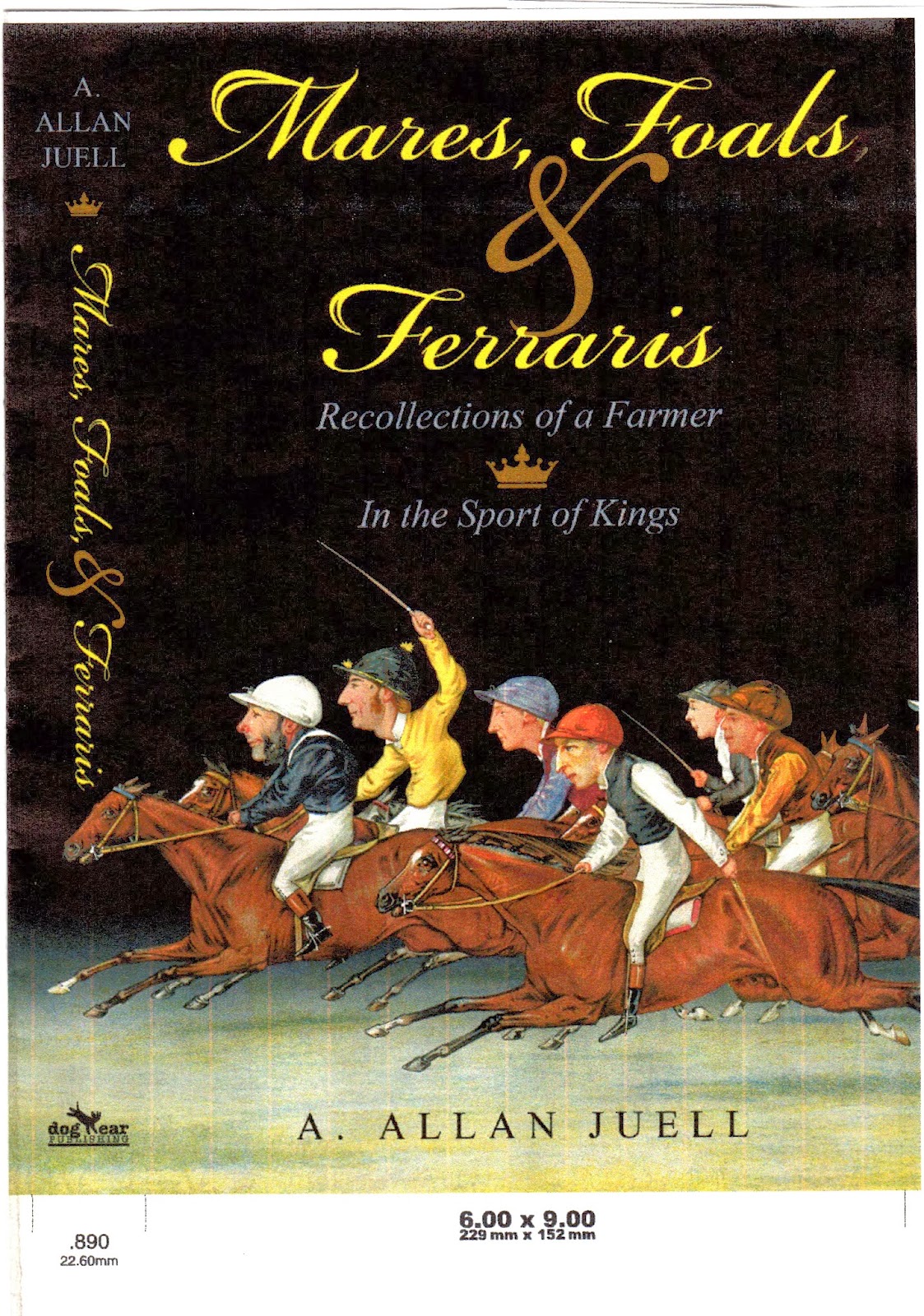
From: "Mare, Foals and Ferraris:"

"So along comes this horse into our perfect world that really isn’t perfect. Instead of our simply noticing the horse has a few questionable habits, we immediately accuse the poor beggar of having vices. According to federal law, a vice is a Class B felony, normally resolved by the perpetrator doing a five-to ten-year stint at a penitentiary, which is not a real productive way to get a horse to the races. Most racing secretaries don’t write races for fifteen-year old maidens that never won one and are ridden by a jockey and a parole officer. Besides, the prisons are already overcrowded with perfect human beings as it is.


I like to refer to vices as aberrations, minor deviations on the equine path of life. Most are relatively harmless and only irritate people because of that perfection thing. I try to impart that philosophy on Jesse whenever she starts exploring my emotional closet. It’s that chromosomal obsession women have to fix something – usually a man. Why more women don’t go into the remodeling business puzzles me. I guess fixing a patio just doesn’t rank up there with 200,000 years of defective genes and the chance to turn Homo defectus into a Cocker spaniel.

Cribbing is a good example of an equine bad habit. Derived from the Queen’s English, the term attempts to explain how some horses grab the ‘corn crib’ (which is basically a food repository), in their teeth and belch in reverse. A corn crib is nothing more than a feed manger – horses don’t do formal dining, so it’s just a box where you throw in the food and clean up the slobber later. That of course demotes most farm managers to something like a busboy at a pie-eating contest. Blame it on the Brits – they always come up with terms that if pronounced with enough nasal discharge somehow sound terribly important, if not totally inaccurate. Horses don’t eat much corn. In England, oats are called corn, probably because England is too cold to grow corn, which brings up the issue of the Boston Tea Party. You see, the British also couldn’t grow tea either because of the cold, so they traded opium for tea with the Chinese figuring that once the habit got going, negotiations would be a lot more one-sided than they already were, allowing for a more aggressive approach for the third leg of their commerce – kidnapping Africans to sell to white people. England sort of specialized in the import and export of bad habits. Boston had to dump the tea since most kidnapped Africans couldn’t swim and well, Chinese dope fiends were in short supply. We actually preferred the French more than the English because mostly they just shopped for clothes. Of course I’m still not sure what the English call corn. Probably wheat. Maybe Canada. I don’t have a clue. However, once independence was assured, we decided to race our horses in the opposite direction – counter-clockwise. You know, don’t slam the gate on your way home.


Horses normally eat hay, oats (corn), barley and grass. Every so often they go for farm manager’s shirts, small BMWs, a farrier’s favorite baseball cap, dirt, rocks and the careless cat. For special treats, they prefer apples, carrots, bananas, grapes and a pint of Guinness. And as I addressed earlier, the appetizer menu includes fence posts, expensive trees and plywood. They prefer interior plywood – something about the glue. Definitely an eclectic diet. And here I thought Guido was the only culinary school dropout.

I don’t think cribbers get enough credit for thinking up the habit. I have never met a cribber who wasn’t smarter than the average horse. After all, most racehorses sit around all day in a stall waiting for something to happen. Usually, nothing does. Maybe a rat runs by, or somebody stops by to sit on their backs, but otherwise it is pretty dull. Some horses get regular visits by rather attractive grooms (girls) with a manure fetish, or more likely, Manuel from Barcelona who gave up maiming bulls in favor of perforating horses with a pitchfork. So, they lock their teeth on the stall door, make a really obnoxious sound and swallow some air. Compared to compulsive vacuum cleaning or getting arrested in a Reno hotel room with your ‘niece,’ the habit seems pretty harmless. But it definitely isn’t perfect. And there’s always the problem of where all that air ends up."


Friday, January 3, 2014

Resolutions for Deranged Farm Managers...


Emphasis on...Resolve:


     Around a farm there are always a lot of things that need to be resolved.  In fact, there are so many of them that they could easily be spread out over six or seven years.  Sort of like depreciating a truck.  Thirty-percent the first year, ten-percent each year afterward and in five years the problem is completely gone.  Not only is it gone, but it generated a refund from the IRS in the process.  Naturally, that was before tax reform.  Nowadays, they would disallow the problem, penalize you an additional bad habit and insist that you only declare resolutions under five-acres in size.  I suppose that they could also conclude that any person with that many problems has little time to run a business.

 
     I don’t think it is totally hopeless.  Tragic maybe.  But after a long year or so of trying to raise horses in the rainforest, managing an urban renewal project financed by subterfuge and counterfeit paperwork while dealing with the vagaries of humanity and the heart in general, I still believe that some resolutions can be met.  I am going to start with these:


1)      I am not going to let Doc breed a mare that is worth less than his lawnmower.  She is going to have to find her own date.


2)      The next time a horse knocks down a fence, I’m going to declare it ‘environmental revisionist thinking ’ and leave it that way.  I have no idea what that means and nobody else will either.


3)      I am never going to lose my temper with a yearling again.  (Well, maybe.)


4)      The stallion will learn some manners.  I’m sure I can hire somebody mean (or terminally ill) to deal with that one.


5)      Maybe consider moving my bed a little further from the window.  Just a foot or so.


6)      I will live to see a vet bill under $500.


7)      I’m going to find a cat with some degree of loyalty and table manners.


8)      I will deal with the manure pile before it decides to deal with me.


9)      All halter breaking will take place in-utero.


10)   I’ll hear a trainer say, “You know, you could be right.”


11)   I am going to check my rubber boots for slugs before I put them on.


12)   I am not going to get my thumb caught in the manure spreader¼again.


13)   I will confess the whole sordid story of farm finances to Elaine.  (The boss's wife.), Actually, I’ll send her an anonymous telegram from Mexico.


14)   I’m never going to try to look smart in front of Jesse again.  Boy, that’s an easy one.  Wonder why it’s so far down the list?


15)   And, if it happens to work and she’s willing, I am going to ask that woman to marry me.  Or go steady, or¼still, I’ll have to quit smoking.  And maybe reconsider the advantages of a college education.  Who knows?  Might write a book or something.
 
From:  Well, you probably guessed that already!

 
Next time:  New Year's Resolutions for Cowboys on the Bozeman Trail

Wednesday, January 1, 2014

Nothing Left to Save...Oh. I'm Not Good with...


Children: A Knight's Last Salvation --
Damn, I was Hoping for One Last Desperate Maiden!


A New Year grinds its relentless path around this crowded planet; reluctant, yet driven by the infinite momentum of the unseen vastness of time itself.  All human crossroads pause here; on this reunion of the millenia…look to the left; the right –engage this moment in the manner of all moments, and by the mad laughter of the self-anointed lunatic, claim that this year will be the year to…


What?


I have dwelled upon the task, knowing full well the weakness of my aging resolve.  Perhaps it is time to embrace my redundancy, grant my guilt before the Courts of Fools and Romantics; allow this worldly Inquisition of Kings and Bishops to have that moment they have coveted for so long.  Cast the roaming wolf from my veins, denounce the Quest as a mortal heresy – pull Rocinante’s heavily worn iron shoes for the very last time.  Sheath the sword of mercy and justice…stand naked in my fading manhood before the early morning throng at some random Starbuck’s…defying the slut of their hearts’ desires to murder me one last time.  And make this death stick for a change.  No half-measures, no last minute pause of the blade.  No reaching for the Half and Half.  May you suffer your coffee black this time!
 Nah…
 
An old Kikuyu chief once said, “When elephants fight, it is the grass that suffers.”  And I have often lamented that each living blade is the child of some future meadow.  This endless Serengeti that nourishes an enduring innocence that is the legitimate core of humanity…the soul that holds no allegiance to the mightier or lesser gods of our creation; for you see, children have no need for gods and temples of gold and stone.  They live by the sustenance of an unknown warmth, nurtured by the milk of gentleness and love, seemingly protected in a world full of fierce and sometimes angry giants.  And like dry sponges they begin to absorb the emotions of the water that churns around their feet – a cognition that all things are not as they once seemed to be.  And with recognition, comes uncertainty and for the first time, the child feels the suffocating hand of doubt.  

But of course, nothing is allowed to stay the same anyway.  A planet guided by evolutionary habits demands that organisms remain in flux -- the nature of thought itself under the constant shadow of extinction.  Miss one lesson and you are kept after class for a very long time.  So perhaps Knights too must change with the times.  After all, distressed maidens now have psychologists, dragons are in short supply or driven to extinction, tyrannical landlords are disguised as simple church-going merchants, while the warlords in their gilded castles own all the best horses and armor in the realm.  And the toiling peasants, long since duped into a catatonic stupor, trading away what little dignity they once owned for cheap toilet paper and diet-sodas.        

So who is left to defend?  Who is really worth defending?  What life is worth the life of a single Knight?  Ah!  But there is still the ancient art of chivalry – a codicil of men, that asks few questions, sees no good or evil other than in the thoughts and hearts of individual men, and grants all who pass mercy in the name of countenance and fair play.  A defender of innocence, the aging warrior that stands between the child and the unrelenting storms of all past miseries and deception…

 Hmmm…

 
And I don’t even like children.  And Rocinante…he bites them whenever he finds the opportunity.  And they smell funny.  Make noise.  Ask stupid questions.  Fart in public.  Call me ‘old’ to my face.

I suppose it has finally come to this it would seem.  Defending a mere hope.  A 50-1 longshot that a juvenile delinquent may one day become that ‘good king’ of the realm – the person who stands before all tyranny; of all stripes and says loudly, “Enough!”  And perhaps then, at that pristine moment, I can raise my sword for the final time and finally send Rocinante out to pasture.  Perhaps somewhere in France, near the ocean, without a single Starbucks in sight. 

Well shoot.  Better clean the tack anyway.  That day might be a few decades and many leagues down the path.  But as often happens, I first feel the winds of change arriving from some distance place beyond the horizon.  And the wonder of that, the maddening curiosity of those moments is what has always driven my horse  forward -- rightly or wrongly, but forward all the same.  Violence is not a disease -- it is a habit.  A bad one.  The giants of the world have the power to destroy.  They also have the power to teach.  It is then merely a matter of choice.     
 
2014 -- Ending Violence is a Matter of Showing, Not Telling.